
Pilgrimage to Montserrat: History & Meaning
How centuries of pilgrims shaped the monastery, sanctuary, and spiritual life of Catalonia
Pilgrimage has been part of Montserrat’s identity for centuries. The mountain developed from an early Marian site into a Benedictine monastery and sanctuary, attracting pilgrims as its religious importance grew during the Middle Ages.
Today, Montserrat remains both a Benedictine monastery and a Marian sanctuary. People continue to come for prayer, religious celebrations, the veneration of Our Lady of Montserrat, and the experience of a place where landscape, history, and religious tradition remain closely connected.
Why Did People Begin Pilgrimage to Montserrat?
The origins of pilgrimage to Montserrat are closely connected to the mountain’s early Marian tradition. The official history of Montserrat records a first documented mention of the mountain in 888 and the foundation of the monastery by Oliba, Abbot of Ripoll and Bishop of Vic, in 1025. The small monastery soon began receiving pilgrims and visitors.
The traditional story of the Virgin’s discovery is associated with a cave on the mountain in 880. According to the tradition, shepherds saw a mysterious light and heard music before discovering an image of the Virgin. The story became part of the religious identity of Montserrat and helped establish the mountain as a place of Marian devotion. It is important, however, to distinguish this religious tradition from the documented historical development of the sanctuary.
As devotion grew, Montserrat became more than an isolated monastic site. The monastery, the image of the Virgin, and the mountain itself gradually formed a destination toward which people travelled specifically for religious reasons.
The story and symbolism of the image itself are explained in our Black Madonna of Montserrat guide.
How Did Pilgrimage to Montserrat Develop?
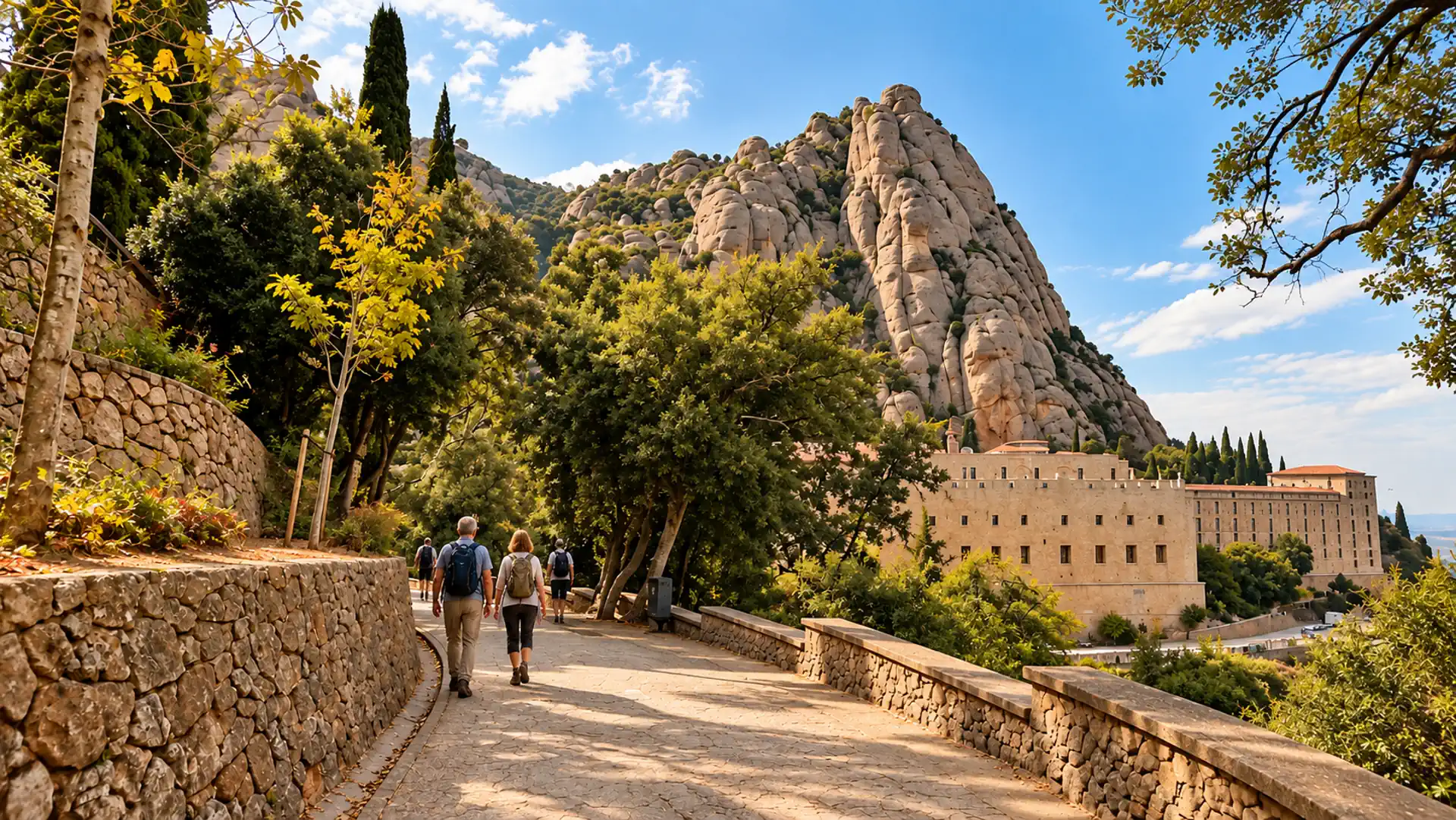
The pilgrimage tradition developed alongside the monastery. During the Middle Ages, reaching Montserrat on foot was part of the experience because there was no modern transport to carry visitors up the mountain. The official Montserrat visitor information describes walking to the sanctuary as a tradition that goes back to the Middle Ages, and groups of pilgrims still continue the practice today.
One of the historic approaches is the Montserrat Pilgrimage Path from Monistrol. The route forms part of a wider network of historic paths, including routes associated with pilgrims travelling toward Santiago de Compostela who stopped at Montserrat. This helps explain why Montserrat became connected not only with local devotion, but with wider pilgrimage traditions across the region.
The history also includes individual pilgrims whose journeys became part of Montserrat’s story. In 1522, Ignatius of Loyola made a pilgrimage to Montserrat before beginning a new stage of his life. The monastery’s own historical chronology records the visit as one of the notable pilgrimages associated with the sanctuary.
The important point is that pilgrimage was not simply a way of reaching the monastery. The journey itself became part of the relationship between the visitor and the mountain.
What Role Does the Holy Cave Play in Montserrat Pilgrimage?
The Holy Cave, or Santa Cova, is one of the most important places in the pilgrimage tradition of Montserrat. According to the traditional account, it was the cave where the image of the Virgin was discovered. The present chapel was constructed between 1696 and 1705, incorporating the original cave into the sanctuary.
The approach to the Holy Cave is also part of the experience. The path from the monastery includes the Rosary Path, decorated with fifteen sculptural groups representing the mysteries of the Rosary. The route was designed not simply as a way of reaching the chapel, but as a place for contemplation and prayer before arriving at the shrine.
For centuries, the Santa Cova has therefore connected several elements of Montserrat in one place: the traditional story of the Virgin, the mountain landscape, religious art, architecture, prayer, and pilgrimage.
For a visitor interested in the history of Montserrat, this is an important distinction. The Holy Cave is not simply another viewpoint or attraction. It is part of the reason the mountain developed as a sanctuary.
What Does Pilgrimage to Montserrat Mean Today?
Pilgrimage to Montserrat is still a living tradition rather than only a historical memory.
The monastery describes Montserrat through a dual identity: a Benedictine monastery and Marian sanctuary. This combination has shaped the site for centuries, bringing together monastic life, prayer, pilgrimage, hospitality, and devotion to the Virgin.
The tradition continues in different forms. Some pilgrims arrive as part of organized religious groups, while others walk independently or visit specifically to pray at the sanctuary. Recent pilgrimages recorded by the Abbey include groups staying at Montserrat for several days, participating in prayer, vigils, Mass, and offerings.
At the same time, many people arrive primarily as travelers interested in history, culture, architecture, or the mountain landscape. They are still entering a functioning religious environment.
That coexistence is important to understanding Montserrat. It is not a former pilgrimage site preserved as a historical attraction. It remains a living sanctuary within a working Benedictine monastery.
Can You Experience Montserrat as a Pilgrim Today?
Yes, although there is no single way to experience pilgrimage at Montserrat.
A visitor can simply explore the monastery and mountain, but those who want to understand Montserrat as a pilgrimage destination can pay closer attention to the elements that give the sanctuary its meaning: the basilica, the shrine of Our Lady of Montserrat, the Holy Cave, the Rosary Path, and the continuing religious life of the monastery.
Walking part of the historic approach can provide another perspective. The official Montserrat information still identifies traditional walking routes used by pilgrims, while modern visitors can also reach the monastery by train, rack railway, cable car, or road.
The important distinction is that experiencing Montserrat as a pilgrimage site does not require reproducing a medieval journey. It means understanding why people came here, what they came to venerate, and how the monastery and sanctuary continue to function today.
For travelers visiting from Barcelona, that historical context can make the visit feel less like a collection of separate sights and more like one connected story.
Understanding Montserrat as a Place of Pilgrimage
Pilgrimage is one of the threads that connects the different parts of Montserrat’s history.
The early Marian tradition, the foundation of the Benedictine monastery, the development of the sanctuary, the Holy Cave, the Black Madonna, and the continuing religious life of the monastery are not separate stories. They are different parts of the same long development.
For centuries, people have travelled to Montserrat not simply to see the mountain, but to approach a place they consider sacred. Some arrived after long journeys on foot. Others came as organized pilgrims. Today, visitors arrive by modern transportation, but the relationship between the mountain, sanctuary, and pilgrimage remains.
Understanding that history helps explain why Montserrat occupies such an important place in Catalonia.
Understanding Montserrat as a Place of Pilgrimage
Pilgrimage is one of the threads that connects the different parts of Montserrat’s history.
The early Marian tradition, the foundation of the Benedictine monastery, the development of the sanctuary, the Holy Cave, the Black Madonna, and the continuing religious life of the monastery are not separate stories. They are different parts of the same long development.
For centuries, people have travelled to Montserrat not simply to see the mountain, but to approach a place they consider sacred. Some arrived after long journeys on foot. Others came as organized pilgrims. Today, visitors arrive by modern transportation, but the relationship between the mountain, sanctuary, and pilgrimage remains.
Understanding that history helps explain why Montserrat occupies such an important place in Catalonia.
For travelers planning a visit, you may also find useful:
Exploring Montserrat from Barcelona
Montserrat is best understood as more than a mountain viewpoint or monastery visit. Its pilgrimage tradition, Benedictine heritage, and spiritual history are part of what gives the mountain its meaning.
A structured private visit allows travelers to explore the monastery and surrounding landscape with historical context and a thoughtful pace.
Explore the Montserrat Day Trip