

Spain Provinces, Regions & Autonomous Communities
Learn how Spain is organized into provinces and autonomous communities, and why understanding Spain’s regional diversity can be useful when planning a trip.
Spain is one of Europe’s most diverse countries, with distinct languages, landscapes, cultures, and traditions found across its different regions.
The country is divided into 17 autonomous communities and 50 provinces. While this administrative structure may seem complex at first, understanding the basics can help travelers better appreciate how different parts of Spain relate to one another.
Whether you are planning a trip to Barcelona, exploring the Pyrenees, or considering a visit to nearby Andorra, knowing how Spain’s regions are organized provides useful context for understanding the country beyond its major tourist attractions.
How Spain Is Organized
Spain consists of 17 autonomous communities, which function somewhat similarly to states or regions in other countries. Each autonomous community has its own government and varying degrees of administrative responsibility.
Within these autonomous communities are Spain’s 50 provinces, which serve as important territorial divisions for administration, statistics, and local governance.
Most travelers encounter the names of autonomous communities more frequently than provinces, but both remain important parts of Spain’s administrative structure.
Spain’s 17 Autonomous Communities
The autonomous communities represent the primary regional divisions of Spain.
Some of the best-known include:
- Catalonia
- Andalusia
- Madrid
- Valencia
- Galicia
- Basque Country
- Aragon
- Castile and León
Each region has its own cultural identity, traditions, architecture, cuisine, and in some cases even its own language.
Spain Provinces Map
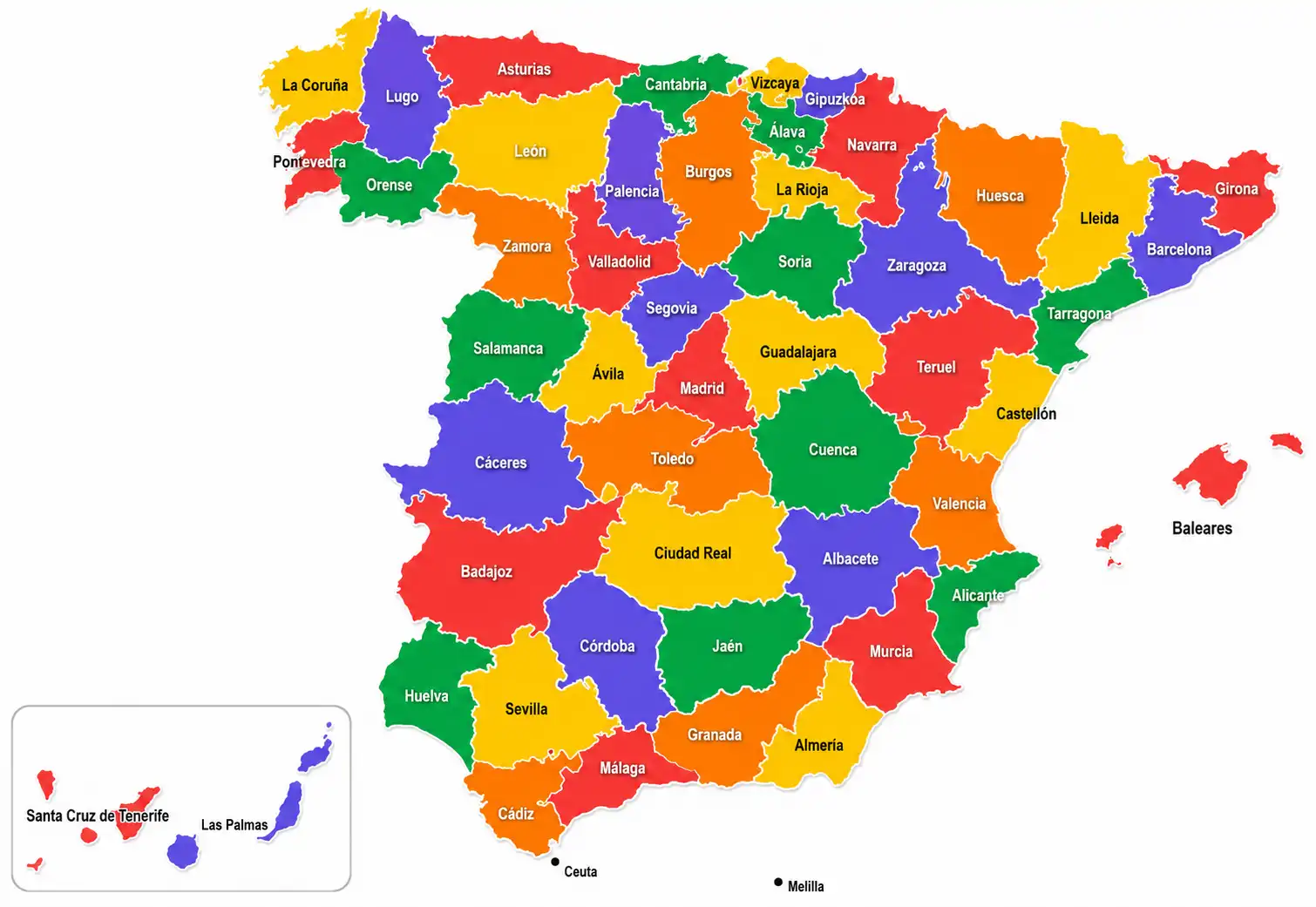
Spain’s 50 provinces are distributed across the country’s 17 autonomous communities.
Many provinces take their name from their capital city, although there are several exceptions.
The map below illustrates how the provinces are distributed throughout mainland Spain and the island territories.
Why Spain Feels Like Several Countries in One
One reason many visitors find Spain fascinating is the strong regional identity found throughout the country.
Traveling from Andalusia in the south to Galicia in the northwest or Catalonia in the northeast can feel like visiting entirely different countries.
Languages, architecture, cuisine, traditions, and even landscapes can change dramatically from one region to another.
This diversity is one of Spain’s greatest strengths and one reason many travelers return multiple times to explore different areas.
Catalonia: The Region Around Barcelona
Catalonia is one of Spain’s most visited regions and home to Barcelona, one of Europe’s most popular cities.
The region has its own language, Catalan, along with a distinct cultural identity and history.
Many travelers visiting Barcelona also explore destinations elsewhere in Catalonia, including Montserrat, the Costa Brava, and the Pyrenees.
Those interested in visiting one of Catalonia’s most important cultural landmarks may find our guide to Montserrat from Barcelona helpful.
The Pyrenees Border Region
Stretching across northern Spain, the Pyrenees form a natural border between Spain and France.
The region is known for its dramatic mountain scenery, historic border crossings, traditional villages, and important role in European history.
During the Second World War, parts of the Pyrenees became important escape routes used by refugees, resistance members, and Allied airmen seeking to reach safety.
Travelers interested in this history can learn more through our guide to WWII Escape Routes in the Pyrenees.
Where Does Andorra Fit?
Many visitors are surprised to learn that Andorra is not part of Spain.
Although located between Spain and France in the Pyrenees mountains, Andorra is an independent country with its own government and unique history.
Because of its location, Andorra is often visited alongside Catalonia and the Spanish Pyrenees, particularly by travelers staying in Barcelona.
You can learn more in our Andorra Travel Guide.
Regions Travelers Often Visit from Barcelona
arcelona is an excellent base for exploring several of Spain’s most interesting regions.
Popular destinations include:
- Montserrat and central Catalonia
- The Costa Brava coastline
- The Pyrenees mountains
- Andorra
- Southern France
Each offers a different perspective on the history, culture, and geography of northeastern Spain.
Understanding Spain Beyond the Map
Spain’s 50 provinces and 17 autonomous communities provide the administrative framework of the country, but they also help explain the remarkable diversity that travelers encounter from one region to another.
For visitors arriving in Barcelona, understanding Catalonia, the Pyrenees, and nearby Andorra can add valuable context to the places they experience during their trip.
While many travelers focus only on Spain’s major cities, exploring the surrounding regions often reveals some of the country’s most rewarding landscapes, history, and cultural traditions.n.